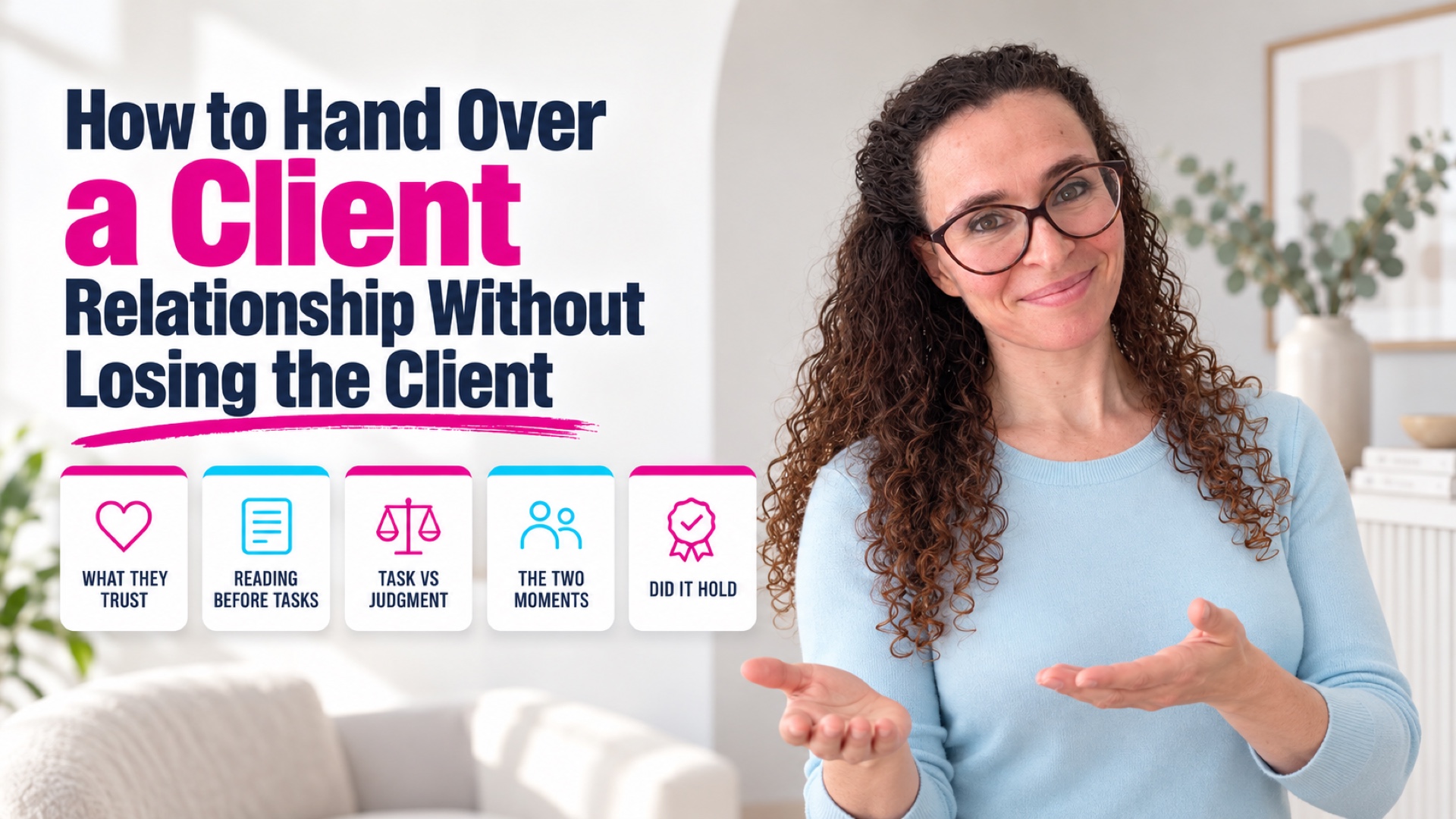
How to Hand Over a Client Relationship Without Losing the Client
Can you hand over a client relationship without losing the client?
Yes, and the part that decides it happens before anyone is introduced. A client stays when the person taking over can read the account the way you read it: what this client is actually buying, what they say when something is wrong, and which two moments still belong to you. Transfer the reading first. The tasks follow on their own.
Who is this for?
You run a business that already sells. A handful of clients know you by name, write to you directly, and would notice within a week if someone else answered. You have someone capable sitting next to you, or you are about to bring someone in, and the work is genuinely ready to move.
And you have not moved it. The account that pays best is the one you would least like to explain, and every time you start writing it down you find yourself listing twenty small things that all sound obvious and none of which you would trust a stranger to get right.
Key takeaways
- Clients rarely leave over the work quality after a handover. They leave when the reading of the account disappears with you.
- Before you hand over a client relationship, write down what that client is actually buying. Most founders discover they have never said it out loud.
- A client is attached to four separate things, and only one of them is the delivery. Name all four before you move any.
- Hand over the judgment first, the tasks second. Doing it the other way round produces a person who executes correctly and reads the account wrong.
- Two moments never transfer on a first pass: the price conversation and the apology.
- Your client is usually more than one person, even in a small company. Map who else has a stake before you assume you know the relationship.
- You know the handover held when the client starts writing to the other person by default, without being redirected.
Table of contents
- Why client relationships break during a handover
- What your client is actually attached to
- Hand over the reading before the tasks
- The task version and the judgment version, side by side
- The two moments you keep, at least at first
- How to know the handover held
- Frequently asked questions
- Recommended tools and resources
- Where to explore next
- Final summary
Why client relationships break during a handover
Almost nobody loses a client because the replacement did the work badly. The work is usually fine. What goes missing is smaller and harder to see.
It is the reading. You knew that when this client sends a three word reply, something is wrong. You knew which request to take literally and which one to answer with a question. You knew that the deadline they gave you is soft and the one they did not mention is not.
None of that lives in a process document. It lives in your head, and it leaves the building with you.
The client feels the change before they can name it. Answers arrive that are technically correct and slightly off. Then they start copying you back in, which is the real signal. When a client puts you back on the thread, the handover has already failed, and you still have time to fix it.
Here is a demonstration you can run in four minutes. Open your inbox and find the last five messages from your most important client. Read only what you wrote back. Now ask yourself, for each reply: what did I know that made me answer this way instead of the obvious way? Write that down in one line per message. Five lines. That is the beginning of the document that actually matters, and almost nobody has it.
What your client is actually attached to
Your client is attached to four things at once, and they do not carry equal weight.
The outcome. What their business gets. This is the easiest to hand over and the one everyone starts with.
The reading. The judgment described above. Hardest to move, and the reason handovers fail.
The voice. How answers sound. Clients notice tone changes faster than quality changes, which is not intuitive until you have watched it happen.
The access. Whether they can reach a decision maker when something goes wrong. Who can say yes, rather than who does the work.
I once read an email sequence from a client who had been using AI to draft everything for months. I knew inside thirty seconds that she had not written it. Every sentence was polished, correct, and belonged to nobody. She had handed over the voice without noticing, and her replies had stopped sounding like the person her audience had chosen.
The same thing happens between two humans. Nobody decides to change the voice. It changes because a different person is typing.
One assumption worth testing before you hand over a client relationship: you may not be dealing with a single contact at all. Gartner's 2025 sales research, from a survey of 632 B2B buyers run in August and September 2024, describes buying groups of five to sixteen people across as many as four functions, and found 74% of buyer teams showed unhealthy conflict during the decision process. Read that with its limits in view. Those are enterprise buying teams, far larger than the companies most established founders serve, and the study measures purchasing decisions rather than ongoing relationships. It proves nothing about your accounts. It is useful for one reason: the person who emails you is often not the only person with a stake, and a handover that introduces one human may be introducing them to the wrong one.
Hand over the reading before the tasks
Here is the sequence that works. It takes about two weeks of ordinary work, not a project.
Step one: name what this client buys. One sentence, written down. Not the service. The result they would describe to a peer. If you cannot write it, you have found your first problem, and it is not a handover problem.
Step two: write the five judgment lines. The ones from the demonstration above. Keep adding as they occur to you. Cap it at fifteen. A longer list stops being read.
Step three: name the role, not the person. This is where a role map earns its keep. The person taking over is holding a named role with defined edges, so both of you know what falls inside it and what comes back to you. Handing over "the client" hands over everything and nothing at once.
Step four: let them shadow live. Not recordings. Live. They read the incoming message, they draft the reply, you send it. Three to five rounds. Every gap between their draft and your send is a judgment line you had not written down yet. Add it.
Step five: flip the direction. They send, you read afterwards. Same five rounds. Correcting after the fact is a different exercise, and the one that tells you whether the reading transferred.
Step six: introduce the change deliberately. One short message from you, naming the person, naming what they own, and saying you are still there. Clients do not resent a handover they were told about. They resent discovering one.
A partner I work with said something plainly on a call last June that has stayed with me. The fear of handing work to a machine and the fear of handing it to a person are the same fear. The tool is not the question. Control is.
The task version and the judgment version, side by side
This example is illustrative, built from the pattern rather than lifted from one account.
The task version. The brief says: send the monthly report by the fifth, answer emails within 24 hours, book the quarterly review. Clear, measurable, easy to check. Two months in, the client has gone quiet. The reports went out on time. Every email got a reply. And a question the client raised sideways in March, the one that was really about whether to keep spending here, got answered as an admin request.
The judgment version. The same brief carries three more lines. This client asks about cost when they are reconsidering the whole thing, so a cost question goes to Flavie the same day. They write long when they are happy and short when they are not. They will never say no directly, so a delayed answer means they are not comfortable.
Same tasks. Same person. Completely different account six months later.
The difference is fifteen lines nobody thought to write, because every one of them felt too obvious to say out loud.
The two moments you keep, at least at first
Two conversations do not transfer on a first pass. Moving them early is how a good handover turns into a lost client.
The price conversation. Any discussion of money, scope changes with a cost attached, or renewal. Not because the other person cannot handle it. Because the client reads who shows up for that conversation as a statement about how much the account matters.
The apology. When something goes wrong, the client wants the person who can make a decision, and they want them fast. A handover is stress tested by the first mistake, and the wrong face at that moment costs more than the mistake did.
Both can move later, on purpose, once the reading has proven it transferred. Neither should move by default in week one.
How to know the handover held
Give it ninety days and watch four signals.
The client writes to the other person first. Without being redirected. This one matters most, and founders forget to check it: a client who still writes to you is a client who has not moved.
You stop being copied. Early on you will be on every thread. By day ninety you should be on few. If you are still on all of them, something in the reading did not transfer, and the threads will tell you what.
The other person asks fewer questions, and better ones. Volume drops, quality rises. Questions about what to do become questions about whether to do it.
Nothing arrives as a surprise. No renewal you did not see coming, no complaint that reached you through a third party. Surprises mean the account is being executed rather than read.
If three of four hold at ninety days, the handover worked. If the client still writes to you by default, go back to step four and shadow live again. Short fix, much cheaper than the alternative.
Frequently asked questions
How long does it take to hand over a client relationship?
To hand over a client relationship on one account: roughly two weeks of live shadowing inside normal work, then ninety days of watching the signals. The calendar time is short. Founders underestimate the writing of the judgment lines, because it means saying things out loud that have never been said.
Should I tell the client I am handing over the relationship?
Yes, in one short message, before they notice. Name the person, name what they now own, and say you are still there. Clients accept a handover they were told about and resent one they discovered.
What if my client only wants to work with me?
Find out what "me" means to them. It is usually one of the four attachments, most often access to a decision maker, and that one can be kept while everything else moves. A client who wants you on every task is often a client who has never been told who else is there.
Can I hand over a client relationship to an AI system instead of a person?
Parts of it, and the same order applies. Anything that runs on a rule can move early. Anything that runs on reading the client needs the judgment written down first, and writing it down is the work either way. Who holds it comes second.
What should I write down before I start?
Three things: what this client buys in one sentence, ten to fifteen judgment lines, and the two moments you are keeping. That fits on one page, and one page gets read.
How do I stop the voice from changing?
Give the other person twenty real replies you wrote to this client and let them draft against those. Voice transfers by imitation with correction, not by a tone guideline nobody opens.
What if the person taking over makes a mistake with the client?
Expect it, and be the one who answers when it happens. Handle it yourself, then hand the recovery back. A mistake handled well builds the new relationship faster than a clean first month does.
Is it better to hire someone or to split the account across my existing team?
Split before you hire when you can. Handing one named role to someone who already knows the business is far shorter than teaching a new person the business and the account at once.
How many client relationships should I hand over at once?
One. Handing over two at once means you cannot tell which signal belongs to which account, and the correction loop stops working.
What if I hand it over and the client leaves anyway?
Ask them directly what changed, and listen for whether they name the work or the reading. If they name the reading, the same gap exists on your other accounts and you have just found it cheaply.
Does this work for clients I have had for years?
Yes, and those take longer, because the reading is deeper and mostly invisible even to you. Plan more shadowing rounds and keep the two moments longer.
Recommended tools and resources
- A single page per client, wherever you already write. What they buy, the judgment lines, the two kept moments. One page, kept current, beats any format.
- Your own sent folder. The best source of judgment lines you will ever have, and it is already written.
- A shared inbox or thread view so drafts can be reviewed before sending during the shadowing phase.
- A recurring fifteen minute review for the first ninety days, with the four signals as the agenda. Dropped once the signals hold.
- A named role map for your business, so a handover moves a defined role rather than an undefined bundle of work.
Where to explore next
- How to delegate without losing control: the general version of the sequence applied here to one account.
- Decisions you should never delegate: a closer look at what stays with you, including the two moments named above.
- How to document a process without writing a manual: the writing method behind the judgment lines.
- Signs your business has outgrown its systems: how to tell whether a handover is the right move right now.
- Where AI does not belong in your business: the same reading question, applied to what you automate.
Final summary
A handover fails in the gap between doing the work and reading the account. The work moves easily. The reading only moves if you write it down, watch it applied live, and correct it while you still have the chance to.
So hand over a client relationship in this order. Name what the client buys. Write the judgment lines. Hand over a named role. Shadow live in both directions. Keep the price conversation and the apology for now. Then watch four signals for ninety days. If the client starts writing to the other person by default, you did not lose them. You gave them someone else who reads them properly.
Ready to look at where your business still runs through you?
If one account would be difficult to hand over tomorrow, that is worth looking at directly rather than describing in the abstract. Book a call and we will look at what is actually holding it, and what it would take to move it.