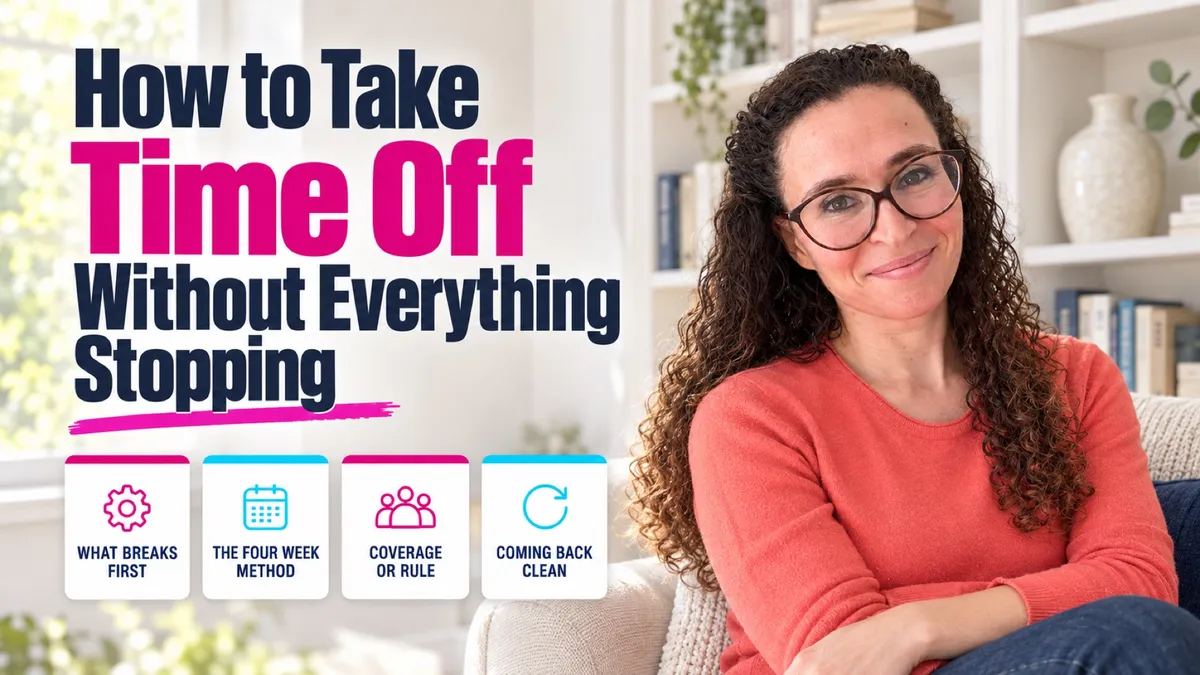
How to Take Time Off as a Business Owner Without Everything Stopping
Can you take time off as a business owner without the business stopping?
Yes, and it has almost nothing to do with how long you're gone. What decides it is whether the work that reaches you every day has a written rule attached to it, or only a person. Give the recurring decisions a rule and a named owner four weeks before you leave. The calendar takes care of itself after that.
Who is this for?
You run a business that already sells. Revenue is real, clients are real, and at least one other person is involved, whether employed, freelance, or simply someone you trust enough to forward things to.
And you haven't been properly away in a while. Not for money reasons. You've done the mental arithmetic of what would land in your inbox on the Tuesday and decided it isn't worth it. So you book four days, answer messages from a train, and come back needing the time off you just took.
Key takeaways
- The length of the absence isn't the variable. Whether decisions have rules attached is.
- Four things break when you leave, and only one of them is the work itself.
- Start four weeks out, not four days. The last week is for handing over, never for discovering.
- Coverage and a decision rule look identical on paper and behave completely differently at 6pm on a Friday.
- Test the absence before you need it. A designed Wednesday off tells you more than a hoped-for August.
- The return matters as much as the departure. Most systems die in the week after the founder comes back.
Table of contents
- Why your business stops when you do
- The four things that actually break when you leave
- The four week method to take time off as a business owner
- Coverage or a decision rule: the same week, two versions
- What the research says about owners and time off
- How to come back without undoing all of it
- Frequently asked questions
- Recommended tools and resources
- Where to explore next
- Final summary
Why your business stops when you do
Your business doesn't stop because the work is hard. It stops because a number of small decisions have no home except your head, and they arrive at a steady rate whether you're there or not.
A supplier asks whether they can deliver a week late. A client wants to move a session. Someone isn't sure which of two prices applies. Each takes you eleven seconds. None takes anyone else eleven seconds, because they'd have to guess what you'd say and live with having guessed wrong.
So the work doesn't pause. It queues. A queue of eleven-second decisions is what you find when you open your laptop on the flight home.
Here's a demonstration you can run in six minutes. Open your calendar and your messages for last week and mark every item where you were the only person who could have answered. Not the ones you happened to answer. The ones where nobody else had the information or the authority.
Count them. Most founders land between eight and twenty for a normal week. That number is your absence problem, written down, and it's usually smaller than the feeling of it.
The four things that actually break when you leave
When an owner goes away, four separate things can fail, and people plan for the wrong one.
The work. Tasks nobody picks up. Everyone prepares for this one, and it's the least common failure, because tasks are visible and people are conscientious.
The decisions. Questions that need a yes or a no from someone with authority. This is where the real damage is.
The exceptions. The thing you've never written down because it only happens twice a year, and it happens the week you're gone. It always does.
The noticing. Whether anyone spots that something has quietly gone wrong. This one is invisible by definition.
That last one is worth sitting with. I once ran an audit for a production company with a real team and real processes, and it surfaced meeting conflicts nobody had noticed. Not new ones. Ones that had been sitting there. Everyone was doing their job, and the thing with no owner went unseen. Absence reveals that at the worst possible moment.
The four week method to take time off as a business owner
Four days before you leave is a handover. Four weeks before is a design. They produce very different Augusts.
Week one: count. Do the six-minute exercise above for a full week, not a remembered one. Write every decision that reached you in a single list, in plain language. "Whether to refund a client who missed two sessions." "Which invoice chases go out and when."
Week two: sort. Three piles. Decisions with an obvious rule you've never written down. Decisions that need judgment but not yours specifically. Decisions that genuinely need you. The first pile is always the biggest, and always a surprise.
Week three: write the rules and name an owner. One line each, with a threshold in it, which makes a rule a much smaller object than a process document. "Refund in full under 48 hours, credit after that, ask me above 500 euros." Then write a name next to it. A rule with no owner is a wish.
Week four: run it while you're still there. This is the part people skip and the one that works. Stay in the building and refuse to answer. Every question that reaches you anyway marks a rule that was unclear, and you can fix it in ten minutes while you're still available.
Then leave, having already tested what you're relying on.
Coverage or a decision rule: the same week, two versions
These two look the same on a handover document. Here's an example, and it's an illustration rather than a case study.
The coverage version. "While I'm away, Sarah is handling client emails." On Thursday a client asks to postpone a delivery by two weeks. Sarah doesn't know whether the deadline is soft, or whether this client has already postponed once. She drafts a careful reply saying she'll check, then messages you, because checking means you. You're in a car park in Italy answering a question about a delivery date.
The decision rule version. "Postponement requests: yes to one, up to three weeks, if they've had none this quarter. Second request, offer a new start date instead. Anything beyond that waits for me." Sarah reads it, checks one thing, answers in nine minutes. You hear about it when you're back.
Same person, same email, same week. What changed is that somebody wrote one sentence containing a number. That's why "make sure someone covers it" is such a comfortable thing to say and such a weak thing to arrange.
What the research says about owners and time off
Adobe surveyed 1,018 people about work and life as business owners, 386 working alone and 632 running small businesses. Respondents reported taking an average of 11 days off a year, excluding national holidays, and nearly half said they struggle to disconnect during the time off they do take. The research reports a 95 percent confidence level and a 3 percent margin of error.
Now the limits, because they matter more than the headline. The data is self-reported, which tends to flatter. The published methodology doesn't state when the survey ran or which country it covers, though the context points to the United States. It mixes people working alone with people running teams, two situations with different constraints. And it measures what owners did, never whether their businesses could have run without them. It describes a pattern and proves nothing about your business.
The second figure is the useful one. Struggling to disconnect during time off you've already booked is a design symptom, and it's the one this article is about.
How to come back without undoing all of it
Most of the work dies in the week after you return, and nobody plans for that week at all.
You come back to a list of things handled while you were away, some of them differently from how you'd have done it. The temptation is enormous and it feels like diligence: you correct a few, and you send three messages beginning with "next time, just check with me first."
Do that twice and the rules are gone. Everyone learns that the real rule was always to ask you, and you've dismantled four weeks of work in one afternoon.
There's a better first day back. Read what happened without changing any of it. Then ask one question of whoever held things: which rule did you have to guess at? Their answer is the only edit worth making. Rewrite that rule, leave the rest alone, and let the decisions stand even where you'd have chosen differently. Two absences handled that way and the rules start to hold on their own.
There's a smaller version of this test you can run without going anywhere. My own week has Wednesdays fully off and every weekday afternoon after four belonging to my children. It's a structure I decided on rather than one I hope for, and it does something a summer holiday can't: it tells me every single week which decisions still have no home except my head. A designed absence you repeat is worth more than a long one you survive.
Frequently asked questions
How long does it take to prepare to take time off as a business owner?
Four weeks for a first proper absence, and most of it is observation rather than work. Counting and sorting take about two hours in total. Writing the rules takes an afternoon. The fourth week costs nothing, because you're doing your normal job while refusing to answer.
What if I don't have a team?
Then the owner of each rule is a scheduled message, or a delay you've decided in advance and communicated. "Replies resume on the 12th" is a rule with an owner. Working alone changes who executes, never whether the decisions were made ahead of time.
Can I just put an out of office message on and disappear?
You can, and it works for about three days. Beyond that, the queue builds and the exceptions arrive. An out of office handles expectations, and expectations are only one of the four things that break.
Which decisions should I never delegate, even while away?
Anything that changes what the business is: pricing structure, taking on a client type you haven't served, ending a relationship. Those wait. The number of things that genuinely can't wait two weeks is smaller than it feels at 11pm the night before you go.
How do I know whether a rule is clear enough?
It contains a number or a named condition, and someone else can apply it without asking a follow-up question. "Be reasonable about refunds" isn't a rule. "Full refund under 48 hours" is. If your test week produces a question about it, it wasn't clear.
What happens when something genuinely goes wrong while I'm away?
You want one escalation path agreed in advance, with a threshold attached. Contact me only if it involves money above a stated amount, a client threatening to leave, or anything legal. Everything else waits. Written down, that reassures the person holding things rather than restricting them.
Isn't this just documenting processes?
It overlaps, with a different emphasis. A process document says how something is done. What you need here is what gets decided and by whom, usually one line rather than one page, and that's what actually blocks people.
My clients specifically want me, not my team. Does this still apply?
Yes, and the rules matter more, because the exposure is higher. Clients attached to you personally accept absence far better than they accept inconsistency. Tell them the dates directly, in advance, and name who holds things. The handover of a client relationship has its own sequence, and it's worth doing before the week you leave.
What if everything falls apart anyway?
Then you've learned which four things have no owner, at a cost of one uncomfortable week. That's a cheap audit. The expensive version is finding out during an illness or a family emergency, when you don't get to choose the timing.
Does any of this need software?
No. The rules live in a shared document, and that's enough for most businesses at this size. Tools help with reminders and visibility once the decisions have been made. They don't make the decisions, and adding one before you've written the rules just moves the confusion somewhere newer.
Recommended tools and resources
- A single shared decision document. One line per recurring decision, a rule and a name. Google Docs or Notion both work. What matters is that it's the only place anyone looks.
- An escalation threshold, written. Three conditions under which you get contacted, with numbers, at the top of that same document.
- Your own calendar and inbox from last week. The best diagnostic material you have, and free.
- A recurring day off, scheduled. The cheapest way to test founder dependency, repeatable, no travel required.
- A written handover note per client relationship. What this client is buying, how they behave when something's wrong, and who answers them now.
Where to explore next
- How to delegate without losing control
- The decisions you should never delegate
- How to document a process without writing a manual
- Signs your business has outgrown its systems
- What to fix first in your business
- Where AI doesn't belong in your business
Final summary
Being able to take time off as a business owner comes down to how many recurring decisions have a written rule and a named owner, and how many still live only with you. Size, revenue and team quality move it far less than people expect. The count is usually between eight and twenty a week, and most resolve to one sentence containing a number.
Four weeks is enough. Count what reaches you, sort it into what has an obvious rule, what needs judgment from someone else, and what needs you. Write the rules, name the owners, then run the whole thing while you're still in the building so the gaps surface while you can still fix them. And plan the week you come back, because that's where this work usually dies.
Ready to look at what actually depends on you?
If you recognised the queue of eleven-second decisions, the useful next step is a conversation about what your business holds in one head, and what it would take to move it.