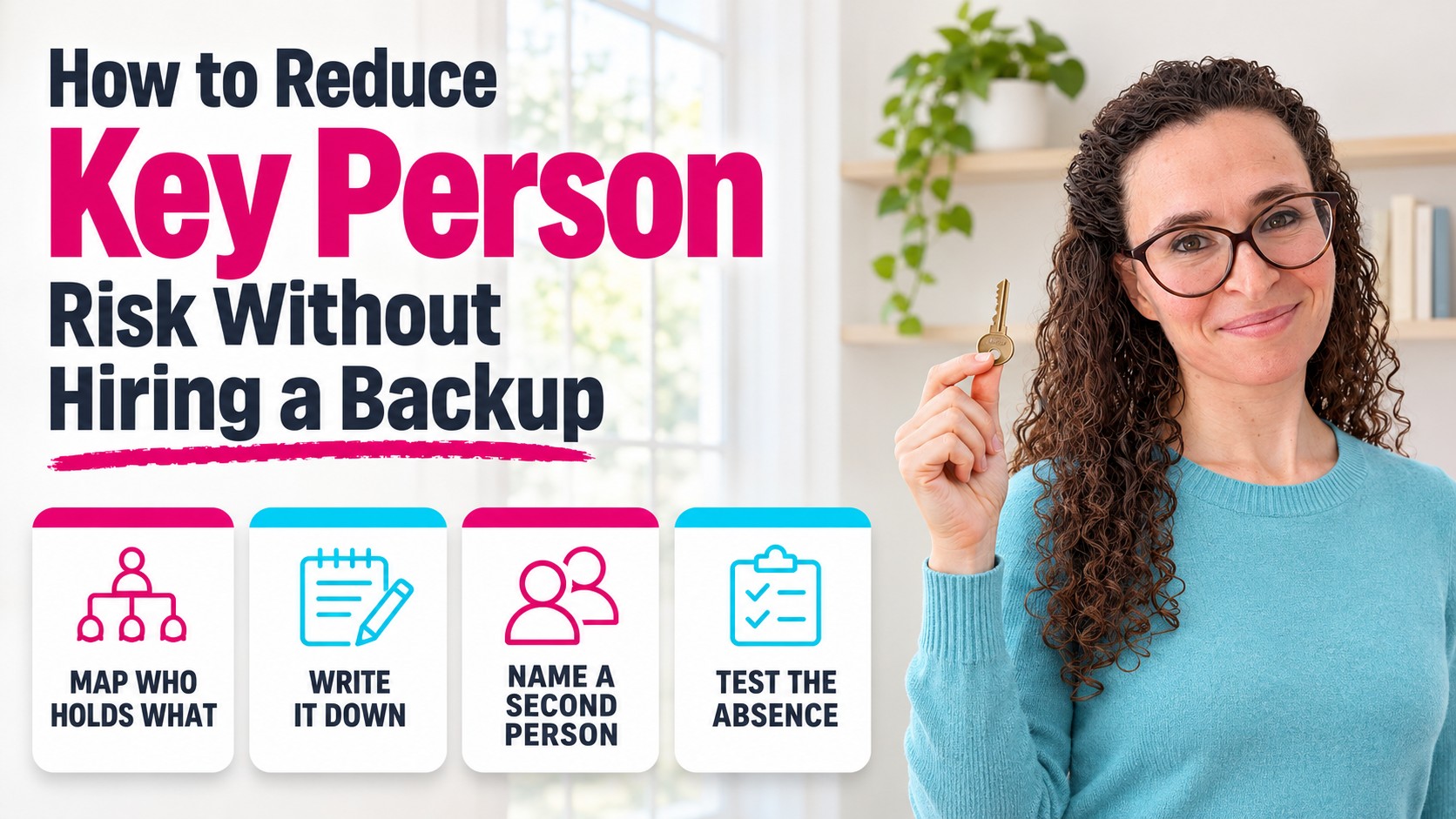
How to Reduce Key Person Risk in Your Business Without Hiring a Backup for Everyone
How do you reduce key person risk in a small business?
You reduce key person risk by finding out which knowledge, relationships and decisions sit with only one person, getting the critical part of it out of their head and into a shared place, naming a second person for each critical task, and testing the setup with a planned absence before an unplanned one tests it for you.
You don't need to hire a backup for everyone. You need a second person who can keep each critical thing going for two weeks.
Below: the four steps, a test for this week, and how to raise it with your key person.
Who is this for?
Your business works, and part of why it works is one person. Maybe it's your operations lead, who knows every supplier and every client quirk. Maybe it's the person who built your systems and is the only one who understands them. Maybe it's you.
When that person is off sick, the business slows down. When they go on holiday, they answer messages from the beach. And somewhere in the back of your mind sits a question you'd rather not ask: what happens if they leave?
If one name comes to mind when you read that question, this is for you.
Key takeaways
- Key person risk is the gap between what one person knows and what the rest of the business can do without them.
- Start by mapping who holds what: knowledge, relationships, access and decisions.
- Write down the critical part, the "how" and the "why", in a shared place the business owns.
- Name a second person for every critical task. Their job is to keep it going for two weeks, not to match the expert.
- Test it with a planned absence, then fix what broke.
- A 2018 survey for Panopto found 42% of workplace knowledge is unique to the individual. Vendor survey, US employees, but a familiar picture.
- AI can help you capture and organise what someone knows. Deciding who holds what stays with you.
Table of contents
- How do you reduce key person risk in a small business?
- What is key person risk?
- How do you know your business depends on one person?
- What changed between 2024 and 2026
- What the research says about knowledge that lives in one head
- Why "we'll deal with it if they leave" stopped working
- The four steps to reduce key person risk in your business
- Do this now: the two-week absence test
- The same Monday, before and after
- When I was the key person
- What if the key person is you?
- Where does AI help, and where doesn't it?
- How do you raise this with your key person?
- How do you know it worked?
- Frequently asked questions
- Do this in the next 7 days
What is key person risk?
Key person risk is what your business stands to lose when one specific person is suddenly unavailable: sick, on leave, burnt out, or gone.
In a business of five or fifteen people, it's ordinary. The one person who knows how invoicing really works. The one who holds your biggest client. The one with the only password to the booking system.
Think of it like a house where every key hangs on one person's keyring. Nothing goes wrong while they're home. The day they're not, nobody gets in.
How do you know your business depends on one person?
You can usually feel it before you can name it. Here are the signs to look for.
- Holidays get negotiated around one person. Nobody plans anything important when they're away.
- The same questions all go to the same desk. "Ask Sarah" is the answer to half of what happens in the business.
- That person answers messages on their days off. Nobody asked them to. Everyone knows things stall if they don't.
- Nobody else can explain why things are done a certain way. The process exists, but the reasons live in one head.
One sign on its own can be normal. Three or more means your business has a key person, whether you planned it or not.
What changed between 2024 and 2026
Two things made key person risk easier to create, and harder to see.
First, small businesses added a lot of tools, usually set up by whoever was most comfortable with tech. Now that person is the only one who knows how they connect.
Second, more work happens in private chats, personal AI conversations and personal accounts, where the business can't reach it.
Teams look more organised, and depend more on the one or two people who understand how it all fits.
What the research says about knowledge that lives in one head
In 2018, the video platform Panopto published its Workplace Knowledge and Productivity Report, based on a survey of 1,001 employees in the United States.
Two findings matter here. Respondents estimated that 42% of the knowledge they need for their job is unique to them, meaning nobody else holds it. And they reported spending 5.3 hours a week waiting for information from colleagues or recreating knowledge that already existed somewhere.
The limits are real. Panopto sells knowledge-sharing software, so it had an interest in the question. The answers are self-reported, from US employees, mostly in larger companies, and the survey is from 2018. It describes a pattern and promises nothing about your business.
Still, read the 42% with your own team in mind.
Why "we'll deal with it if they leave" stopped working
Most founders know they have a key person. Most decide to deal with it later, when it happens. That plan fails for three reasons.
Departures rarely come with time to prepare. Illness, a family emergency, burnout, a competitor's offer. The person who could have trained someone is already gone, or too stretched to do it well.
The knowledge is hard to see. You can't ask someone to hand over what neither of you knows they hold.
It shapes the business long before anyone leaves. The key person can't take a real holiday, and every decision in their area waits for them.
So you make the decision now, while everyone is still here and available to help.
The four steps to reduce key person risk in your business
These four steps take a few weeks alongside normal work. You need a page, honest conversations, and your key person on board.
Step 1: Map who holds what
Start with a simple table. One row per person in the business, you included. Then four columns.
- Knowledge. What does this person know how to do that nobody else does? Processes, workarounds, client preferences, the history of why things are set up the way they are.
- Relationships. Which clients, suppliers, partners or referrers deal mostly or only with this person?
- Access. Which accounts, passwords, files and tools can only this person open or change?
- Decisions. Which decisions wait for this person, even when they're small?
Fill it in with each person, not about them. Ask: "If you were away for two weeks without your phone, what would stop?" Then ask their colleagues. The answers rarely match, and the gaps are useful.
Expect the table to be uneven. One or two rows will be full. Those are your key people.
Now mark each item Critical or Can wait. Critical means something breaks within two weeks without it: clients don't get served, money doesn't come in or go out, a legal deadline is missed. Everything else can wait.
You're looking for the critical items held by one person only.
Step 2: Get it out of one head
For each critical item, the knowledge needs to exist somewhere the business owns. A shared folder, a shared drive, a team workspace. Never a personal account, never a private chat.
Capture three things for each critical item.
- The how. The steps, in order, written plainly enough for a capable colleague who has never done it.
- The why. The reasons behind the odd parts. "We invoice this client on the 25th because their finance team closes on the 28th." This is the part that disappears first and costs most when it's gone.
- The exceptions. What to do when it doesn't go to plan, and who to call.
Don't ask the key person to write a manual. Ask them to do the task once while recording their screen and talking through it. Someone else turns it into a guide, and the key person checks it.
For access, move every critical account to a business-owned login or a shared password manager. No critical password should live in one person's memory or one person's browser.
For relationships, introduce a second contact: copy a colleague on the client update, bring them to the next supplier call.
Step 3: Name a second person
Every critical item now gets a named second person. Write their name next to the item in your table.
The second person's job is not to be as good as the key person. Their job is to keep the item going for two weeks: follow the guide, handle the normal cases, and know which exceptions can wait.
Choose someone who already works close to the area. They learn faster and care more.
Then give them real practice. They do the task once with the key person watching but not touching, then once alone, with questions afterwards.
Don't pile every critical item onto the same second person, or you've only moved the risk.
Step 4: Test it with a planned absence
A setup you haven't tested is a setup you hope works. So plan an absence.
Pick a week when the key person takes real time off, or simply works on something else with notifications off. Tell everyone in advance. During that week, the second people run the critical items, using the guides.
Keep a short log of every time someone needed the key person, and what for. When they return, go through it together. Each entry is a gap: fix the guide, move the access, add the exception. Plan the next test in three months.
The first test always finds gaps. Better in a planned week than in an emergency.
Do this now: the two-week absence test
Take a page and write the name of the person your business depends on most. If it's you, write your own name.
Now imagine they're away for two weeks, starting tomorrow, with no phone. Go through a normal two weeks in your head, day by day.
- Monday morning: what lands on their desk first? Who handles it?
- Payday, invoicing day, the weekly client update: who does each one?
- A client calls with a problem only they have handled before. Who picks up?
- Something breaks in a tool they set up. Who can log in?
For every question where your honest answer is "nobody" or "we'd wait", write one line. That list is the critical part of your exposure.
Circle the one that would hurt most in the first week. That's where Step 2 starts.
The same Monday, before and after
Here's an example, built to show the difference. It isn't a client case.
Before. The operations lead is off sick on Monday. Two client invoices don't go out, because she's the only one who knows the billing exceptions. A supplier calls about a late delivery, and nobody knows what was agreed. The founder spends the afternoon searching email threads, then messages the operations lead at home anyway.
After. The operations lead is off sick on Monday. The account manager sends the invoices using the billing guide, including the note on the client who pays on the 25th. The supplier calls, and the agreement sits in the shared supplier file. The founder's afternoon goes to the work she had planned. The operations lead rests.
Same team, same clients, same Monday. The difference is a table, a few guides, and two people who practised once.
When I was the key person
Before I started my own business, I spent years in corporate roles. And for a long stretch, I was the key person myself.
I remember spending my summers, my holidays, "always responding to emails and messages because I was the one knowing what they were needing." Nobody had planned it that way. It had happened one task, one request, one relationship at a time.
From the inside, it felt like being useful. It also meant I never fully left work, and the organisation never saw its weak point, because I kept covering it. The key person is usually your most reliable person, and that reliability hides the risk.
What if the key person is you?
In many established small businesses, the biggest row in the table is the founder's. You hold the key client relationships, the pricing logic, the reasons behind every decision, and half the passwords.
The four steps work the same way, with one difference: you need someone to ask you the questions, because you can't see your own row clearly. Ask a senior team member to interview you with the two-week absence test, and write down what they notice.
Some things should stay with you: the direction of the business, the decisions with real consequences, the relationships that exist because of you. Reducing key person risk doesn't mean making yourself irrelevant. It means the business keeps running for two weeks when you step away, and nothing critical depends on your memory alone.
A business that can't run two weeks without its founder is also hard to sell and hard to grow.
Where does AI help, and where doesn't it?
Where it helps:
- Turning a screen recording or a voice memo of a task into a first draft of a written guide.
- Organising scattered notes, email threads and documents into one readable file per process.
- Answering a new team member's questions from the guides you've written, once those guides exist.
Where it doesn't:
- Deciding what is critical. It doesn't know which client would leave if an invoice arrived late.
- Building relationships. A client trusts people, and a second contact has to be a real person they've met.
- Replacing the second person. A guide nobody has practised is a document, not a backup.
One trap: an AI setup only one person understands is a new key person. If your assistant, automations and prompts live in one account, add them to the table in Step 1.
How do you raise this with your key person?
The fear here is real. Ask someone to document everything they know, and they may hear "we're preparing to replace you".
So say why, plainly. "You're the person this business relies on most. That's a compliment, and it's also a problem for you: you can't really switch off. I want you to be able to take a holiday without your phone."
Then make them part of the design, not the subject of it. They choose the second people with you. They check every guide. They decide which exceptions still come to them.
And say out loud what the freed time is for: work that needs their judgement, with a real example. People resist handover when it feels like a loss, and welcome it when it feels like relief.
How do you know it worked?
Check four things three months after you start.
Did the key person take time off without being contacted? That's the clearest signal there is.
Did the planned-absence log get shorter between tests? Fewer entries means fewer gaps.
Can the second people do each critical item without asking? Ask them. Their confidence tells you more than the guides do.
Does every critical account have business-owned access? Check it, line by line.
If most answers are yes, go back to your table and look at the next row.
Frequently asked questions
What is key person risk in a small business?
Key person risk is what a business stands to lose when one specific person becomes unavailable. In a small business, it usually means one person holds critical knowledge, client relationships, account access or decisions that nobody else can cover.
How do I know if my business has key person risk?
Look for a few signs: holidays planned around one person, the same questions always going to the same desk, someone answering messages on days off, or work that only happens when they're present. Three or more signs usually mean you have a key person.
How do you reduce key person risk?
Map who holds what, write down the critical knowledge in a place the business owns, name a second person for each critical task, and test it with a planned absence. Fix the gaps, then repeat every three months.
Do I need to hire someone to reduce key person risk?
Usually not. Most small businesses handle it with the team they already have, by naming a second person for each critical task and giving them real practice. Hiring helps only when nobody in the team can take on the second role.
Is key person insurance enough?
Key person insurance can pay the business money if a key person dies or becomes seriously ill. It doesn't move knowledge, relationships or access to anyone else, so it sits alongside these steps.
How do I get a key employee to share what they know?
Explain the benefit for them, such as real time off. Involve them in choosing the second people and checking the guides, and ask them to record a task instead of writing a manual.
What should I document first?
Start with the critical items: anything that would break within two weeks without the key person, such as billing, payroll, key client deliveries or legal deadlines. Within those, begin with the one that would hurt most in the first week.
What if the key person is the founder?
The same four steps apply. Ask a senior team member to run the two-week absence test with you, because founders rarely see their own row clearly. Keep the direction and the major decisions, and move the rest.
Can AI reduce key person risk?
AI can help turn recordings and notes into written guides and organise scattered knowledge. It can't decide what's critical, build client relationships, or practise a task. An AI setup only one person understands creates a new dependency.
Do this in the next 7 days
- Day 1. Run the two-week absence test for the person your business depends on most. Write one line per "nobody" or "we'd wait".
- Day 2. Start the who-holds-what table: one row per person, columns for knowledge, relationships, access and decisions.
- Day 3. Sit down with your key person. Explain why, in terms of their benefit, and fill their row together.
- Day 4. Mark each item Critical or Can wait. Circle the critical items held by one person only.
- Day 5. Move every critical account to business-owned access or a shared password manager.
- Day 6. Ask the key person to record themselves doing the most critical task once, talking through it.
- Day 7. Name a second person for that task, book their first practice session, and put a planned-absence week in the calendar within the next two months.
Recommended tools and resources
- A simple spreadsheet for the who-holds-what table.
- A screen recorder you already have, to capture a task with the reasons spoken out loud.
- A shared drive or team workspace the business owns, so guides never live in a personal account.
- A shared password manager, so no critical access depends on one person's memory.
- An AI assistant you already use, to turn recordings and notes into first-draft guides once you've decided what's critical.
- Panopto, Workplace Knowledge and Productivity Report (2018), for the survey on how much workplace knowledge sits with one person.
Where to explore next
- How to organise your business so it depends less on you
- How to document a process without writing a manual
- How to delegate without losing control
- How to hand over a client relationship
- How to take time off as a business owner
- How to decide what to stop doing in your business
Final summary
Key person risk builds up quietly, one task and one relationship at a time, usually around your most reliable person. Their reliability hides it until the day they're unavailable.
You reduce it in four steps: map who holds what, get the critical part out of one head and into a place the business owns, name a second person who has practised, and test it with a planned absence. Done every few months, it lets your key people switch off and keeps your business running when they do.
Whose absence would your business feel first?
If one name came to mind while you read this, it's worth looking at how the business is designed around that person before something forces the question. Book a call and we'll look at it together.